
On this page
TL;DR
Grip strength matters for lifting, combat sports and everyday life, and is a useful marker of overall strength: in the PURE study of nearly 140,000 adults, every 5kg lower grip strength was associated with a 16% higher risk of death from any cause. Build grip with farmers carries, dead hangs, heavy holds, plate pinches and towel pulls two or three times a week.
Key takeaways
- Grip limits how much you can pull and carry.
- Lower grip strength is linked with higher mortality risk.
- Carries, hangs and heavy holds build grip fast.
- Train without straps where you safely can.
Grip strength matters because your hands are the link between you and everything you lift, carry, pull or hold on to, from deadlifts and pull-ups to shopping bags and grandkids. It's also a widely used marker of overall strength: in a large international study, lower grip strength was linked with higher risk of death from any cause. You can build it fast with farmers carries, dead hangs, thick grips and heavy holds, two or three times a week.
What does the research say about grip strength?
The PURE study followed nearly 140,000 adults in 17 countries for about four years. It found that every 5kg lower grip strength was associated with a 16% higher risk of death from any cause, and grip strength predicted cardiovascular death better than blood pressure did. That's an association, not proof that squeezing a gripper adds years to your life. But it shows grip is a useful window into how strong and robust your whole body is.
Why does grip matter for training?
- It limits your pulling. If your hands give out on deadlifts, rows or pull-ups, your back and legs never get a full workout.
- Combat sports run on it. BJJ, wrestling and judo are all about grip fighting. See the best supplements for BJJ.
- Strongman and HYROX test it. Farmers walks, sled pulls and stones all burn the forearms.
- Everyday life needs it. Opening jars, carrying bags, holding on when you slip.
What are the best grip strength exercises?
| Exercise | How | Sets |
|---|---|---|
| Farmers carry | Walk holding heavy dumbbells or kettlebells | 4 x 30 to 40m |
| Dead hang | Hang from a pull-up bar, arms straight | 3 x as long as you can |
| Heavy holds | Hold the top of a deadlift for time, no straps | 3 x 15 to 30 seconds |
| Plate pinch | Pinch two weight plates together, smooth sides out | 3 x 20 seconds per hand |
| Towel pull-ups or rows | Drape towels over a bar and grip them instead | 3 x 5 to 8 |
Add two of these to the end of two or three sessions a week. Increase weight or time when they feel easy.
How strong should your grip be?
Grip is usually measured with a handheld dynamometer, and normal values vary a lot with age, sex and body size. Rather than chase a number, use simple tests: can you dead hang for 60 seconds? Can you carry half your body weight in each hand for 30 metres? If not, that's your target.
What else supports a strong grip?
- Train without straps where you safely can. Save straps for your heaviest pulling sets.
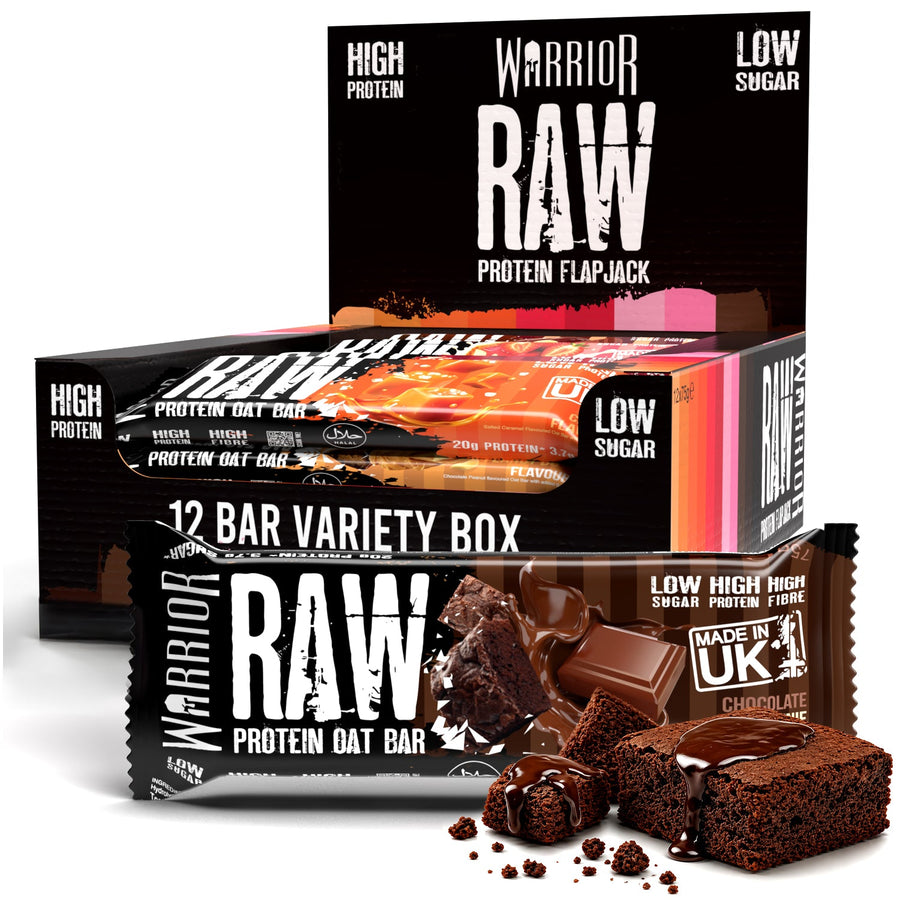
- Eat enough protein: it contributes to the growth and maintenance of muscle mass, forearms included. A Warrior RAW bar gives 20g.
- Use creatine: it increases physical performance in successive bursts of short-term, high-intensity exercise (3g a day). Warrior Creatine + Electrolytes makes it one scoop.
- Keep doing it into older age. Strength is use-it-or-lose-it. See strength training over 60.
Common questions
Is grip strength linked to how long you live?
In large studies, lower grip strength is associated with higher risk of death. It's a marker of overall strength and health, not a direct cause.
How long does it take to improve grip strength?
Many people notice a difference within a few weeks of training grip two or three times a week.
Are grip trainers worth it?
They can help, but carries, hangs and heavy holds train grip the way you actually use it.
Should I use lifting straps?
For your heaviest pulling sets, straps let your back and legs do the work. For everything else, train without them to build your grip.
The bottom line
Grip is the handshake between you and the weight, and a useful marker of how strong you are overall. Build it with farmers carries, dead hangs, heavy holds and plate pinches two or three times a week, train without straps where you can, and back it up with protein. Strong hands, strong for life. That's the Warrior Code.
Sources
- Leong DP et al. (2015). Prognostic value of grip strength: findings from the Prospective Urban Rural Epidemiology (PURE) study. The Lancet 386(9990):266-273. https://doi.org/10.1016/S0140-6736(14)62000-6
- Jäger R et al. (2017). International Society of Sports Nutrition position stand: protein and exercise. Journal of the International Society of Sports Nutrition 14:20. https://doi.org/10.1186/s12970-017-0177-8
- Great Britain nutrition and health claims (NHC) register. https://www.gov.uk/government/publications/great-britain-nutrition-and-health-claims-nhc-register
- Tesco: Warrior RAW Protein Flapjack Peanut Butter Cup 75g (£1.00; 20.1g protein). https://www.tesco.com/shop/en-GB/products/321030370 (checked 19 November 2026)
 Shop the guideWarrior Creatine Plus Electrolytes
From £9.49