
On this page
TL;DR
Creatine helps runners most in short, hard efforts: intervals, hills, sprint finishes and strength training, rather than steady miles. A 2021 review found no evidence that creatine causes dehydration, cramps or heat illness. It can add a little water weight early on, so trial it in a training block, take 3g a day and skip loading.
Key takeaways
- Creatine helps short, hard efforts more than steady running.
- It doesn't cause dehydration or cramps, research shows.
- It can add a little water weight early on.
- Trial it in training, not race week.
Creatine isn't a classic endurance supplement, but it can still help runners. Its strongest evidence is for short, hard efforts, so it's most useful for intervals, hill reps, sprint finishes and the strength work that keeps runners robust. Research reviews also find no evidence that creatine causes dehydration or cramps. The trade-off is a little extra water weight early on, which matters more for some runners than others.
Does creatine help endurance running?
Not directly for steady running. Creatine helps your muscles regenerate energy quickly during short, intense efforts. In Great Britain, the authorised claim reflects that: creatine increases physical performance in successive bursts of short-term, high-intensity exercise, with a daily intake of 3g. For long, steady runs, the main fuel is carbohydrate and fat, not creatine. The International Society of Sports Nutrition's position stand notes that creatine may still help endurance athletes in the parts of training and racing that involve harder efforts.
Where can creatine help runners?
| Type of running | Is creatine likely to help? |
|---|---|
| Intervals, hill reps, track sessions | Yes: repeated short, hard efforts |
| Sprint finishes, parkrun kicks | Possibly, for the hard final push |
| Strength training for runners | Yes: it helps in the gym, and from 55 can enhance the effect of resistance training on muscle strength |
| Steady easy runs and long runs | Unlikely to make a direct difference |
| HYROX and mixed events | Yes, for the stations and surges. See creatine for HYROX |
Does creatine dehydrate you or cause cramps?
The evidence says no. A 2021 review of common questions and misconceptions about creatine concluded that creatine does not increase the risk of dehydration, cramping or heat illness, and some studies suggest the opposite. Creatine draws water into muscle, which is where the myth came from. More detail in does creatine dehydrate you?
What about hot weather running?
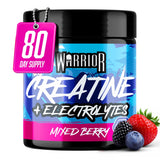
Hydration still matters, creatine or not. Drink to thirst on shorter runs, and plan fluids and sodium for long or hot runs, because you lose sodium in sweat. That's one reason many runners like having creatine and electrolytes in one drink: Warrior Creatine + Electrolytes puts both in one daily scoop.
Will creatine make me heavier?
It can add a little body weight in the first weeks, mostly water stored in muscle. For a sprinter or a lifter, that's no problem. For a marathon runner chasing every second, it's worth trying in a training block well before a goal race to see how you feel, rather than starting just before race day. Taking a steady daily dose rather than loading tends to make the change more gradual.
How should runners take creatine?
- 3g of creatine a day, every day, rest days included.
- No need to load: daily use gradually tops up your muscles. See is creatine loading necessary?
- Any time of day: consistency matters more than timing.
- Start in a training block, not race week.
Common questions
Should marathon runners take creatine?
It won't directly improve steady marathon pace, but it can help with interval sessions and gym work. Trial it well before a race in case the extra water weight bothers you.
Does creatine cause cramps when running?
Research reviews have found no evidence that creatine increases cramping.
Is creatine good for 5k runners?
It may help with hard intervals and sprint finishes, which matter more in shorter races.
Can I take creatine with electrolytes?
Yes. That's exactly what functional creatine like Warrior Creatine + Electrolytes is for: one scoop, one daily habit.
The bottom line
For runners, creatine is most useful for intervals, hills, sprint finishes and strength work, not steady miles. It doesn't cause dehydration or cramps, but it can add a little water weight, so trial it in training. Take it daily, skip the loading, and keep your fluids and sodium in check on long or hot runs. Try Warrior Creatine + Electrolytes.
Sources
- Kreider RB et al. (2017). International Society of Sports Nutrition position stand: safety and efficacy of creatine supplementation in exercise, sport, and medicine. Journal of the International Society of Sports Nutrition 14:18. https://doi.org/10.1186/s12970-017-0173-z
- Antonio J et al. (2021). Common questions and misconceptions about creatine supplementation: what does the scientific evidence really show? Journal of the International Society of Sports Nutrition 18:13. https://pubmed.ncbi.nlm.nih.gov/33557850/
- Great Britain nutrition and health claims (NHC) register. https://www.gov.uk/government/publications/great-britain-nutrition-and-health-claims-nhc-register
- Warrior: Warrior Creatine Plus Electrolytes. https://teamwarrior.com/products/warrior-creatine-plus-electrolytes (checked 20 November 2026)
 Shop the guideWarrior Creatine Plus Electrolytes
From £9.49