
On this page
TL;DR: No. A systematic review of controlled trials found no evidence that creatine at recommended doses hinders heat tolerance or body-fluid balance, including in athletes exercising in the heat. Creatine moves water into muscle cells, which is why the scale can tick up. The early warnings were based on limited data and self-reported surveys. Take creatine every day with a decent glass of water, and plan fluid and sodium separately for long, sweaty sessions.
Does creatine dehydrate you? It is still one of the most common creatine questions, sitting on the worry list next to weight gain and hair loss.
The short answer: at recommended doses, creatine does not dehydrate you. Controlled trials of athletes exercising in the heat have not shown creatine impairing hydration or heat tolerance.
Here is where the myth came from, what the research says, and how to take creatine sensibly through a British heatwave or a sweaty indoor class.
Where the creatine dehydration myth came from
The worry has a clear origin. In the early 2000s, with limited data and based mainly on speculation, the American College of Sports Medicine recommended that people controlling their weight and exercising intensely or in hot environments should avoid creatine. That is how the 2021 expert review in the Journal of the International Society of Sports Nutrition describes it.
At around the same time, surveys of athletes reported cramps and dehydration among creatine users. But those were self-reports that did not control for dose, other supplements or training conditions.
There was also a plausible-sounding theory: creatine draws water into muscle, so perhaps it pulls water away from everywhere else. That theory has since been tested in controlled trials. It has not held up.
Creatine and hydration: what the research actually shows
In 2009, a systematic review with meta-analysis in the Journal of Athletic Training asked the exact question: does creatine supplementation hinder exercise heat tolerance or hydration status?
The authors screened 95 papers and selected ten high-quality controlled studies. Their conclusion was blunt: no evidence supports the idea that creatine hinders the body's ability to dissipate heat or negatively affects fluid balance. Controlled trials of athletes exercising in the heat reported no adverse effects at recommended doses.
That finding has not reversed. The 2021 expert review states that the self-report surveys are contradicted by experimental and clinical evidence.
What actually happens to your body water
- Creatine stores in muscle rise over the first few weeks.
- Water follows creatine into the muscle cell.
- Total body water can rise slightly, and scale weight often follows.
- Controlled heat trials have not shown sweat rate or core temperature getting systematically worse at recommended doses.
How much weight? It varies. The 2021 review notes that a loading phase of about 20g a day for 5 to 7 days typically adds 1 to 3kg, mostly water. Without loading the rise is more gradual, though it can end up similar: in a 2018 creatine-electrolyte trial, with no loading phase, the supplement group still gained an average of 1.6kg over six weeks. Most of that early change is water in muscle, not fat and not dehydration.
The population data wrinkle
One newer study complicates the picture, so it is worth knowing about. A 2025 analysis of US NHANES survey data looked at dietary creatine from food in almost 99,000 people. Both the lowest and highest intakes were associated with altered plasma osmolality compared with moderate intakes, and higher intakes were associated with lower measured body-water volumes.
This is observational food-intake data, not a supplement trial, and it cannot show cause and effect. But it is a useful reminder: hydration is a system. Food, drink, sodium, alcohol, caffeine and training all play a part. No single scoop decides it.
Creatine and cramps: what is more likely to blame
The early cramp reports came from those uncontrolled athlete surveys, and controlled research has not backed them up. Creatine became a convenient scapegoat because it was new, popular and easy to point at.
What actually causes exercise-associated cramp is still debated. Research points mainly to muscle fatigue and unfamiliar training loads or distances. Heavy sweat sodium losses may play a part for some athletes, but the evidence is mixed. Heat, poor sleep and alcohol the night before do not help either.
If you cramp in long or hot sessions, look at pacing, training progression, fuelling and your fluid and sodium plan for that session before you blame the creatine.
Creatine in the heat: how to train through summer
- Take creatine every day, not only on training days.
- Take it with a proper glass of water. 300 to 500ml is the mixing volume, not your whole plan for a 90-minute run.
- Plan long, hot sessions separately. If you see white salt marks on your cap or kit, you are a salty sweater and may want a dedicated sports drink or extra sodium for those sessions.
- Do not start a loading phase in the same week you fly to a hot race or start a new training block.
- Weigh yourself before and after a hard session. Each kilogram lost is roughly a litre of fluid. A common sports-science guide is to replace about 1.25 to 1.5 litres for every kilogram lost, spread over the next few hours.
There is no universal "three litres plus creatine" rule. Thirst, urine colour and body-weight change are better guides than any fixed number. And drinking very large volumes of plain water in long endurance events can, rarely, dilute blood sodium. Creatine does not cause that.
Creatine and electrolytes in one sugar-free drink
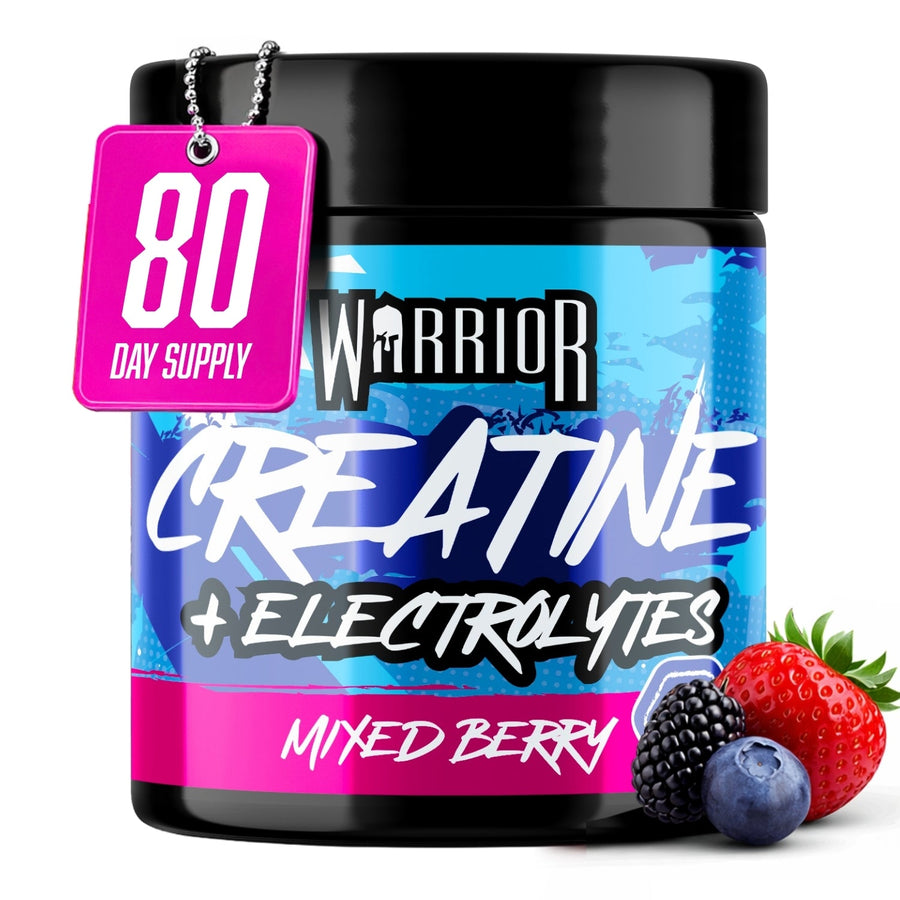
Warrior Creatine + Electrolytes puts creatine monohydrate and an electrolyte blend of sodium, potassium and magnesium into one sugar-free drink. It was named Champion in the Vitamins & Supplements category of The Grocer's New Product Awards 2026. It is a daily drink, not a replacement for a full sports drink on a long, hot session.
Who should check with a clinician first
Creatine has been studied for more than 30 years and has a strong safety record in healthy people at recommended doses. We cover that research in Is Creatine Safe Long-Term?
Speak to your GP or pharmacist before using creatine or electrolyte products if you have kidney disease, take diuretics or blood pressure medication, have been told to restrict sodium, have a history of low blood sodium (hyponatraemia), or are pregnant or breastfeeding.
Does creatine dehydrate you? The group-chat version
- Creatine does not dry you out at recommended doses.
- The early scale bump is mostly water in the muscle you are training.
- Cramps are more likely to be fatigue, unfamiliar load and heat.
- For long, sweaty sessions, plan fluid and sodium on their own merits.
Curious why people pair creatine with electrolytes anyway? Read creatine and electrolytes: should you take them together?, or see creatine monohydrate vs Creatine Plus. More myth-busting lives in the Creatine Knowledge Hub.
FAQs: creatine, dehydration and cramps
Does creatine dehydrate you?
No. A 2009 systematic review of controlled trials found no evidence that creatine at recommended doses hinders heat tolerance or negatively affects body-fluid balance, including in athletes exercising in the heat.
Does creatine cause cramps?
Controlled research has not shown creatine causing muscle cramps at recommended doses. The early reports came from uncontrolled surveys. Fatigue and unfamiliar training loads are more likely culprits.
Should I stop taking creatine in summer?
No. Keep taking it daily with a proper glass of water, drink to thirst, and plan fluid and sodium separately for long, hot sessions.
How much water should I drink with creatine?
Mix each serving in 300 to 500ml of water and drink to thirst across the day. After hard sessions, weigh yourself: each kilogram lost is roughly a litre of fluid to replace.
Why does creatine make the scale go up?
Creatine draws water into muscle cells, so body weight often rises a little in the first few weeks, and more if you load. That is mostly water in muscle, not fat and not dehydration.
Sources
- Lopez RM et al. Does creatine supplementation hinder exercise heat tolerance or hydration status? A systematic review with meta-analyses. J Athl Train, 2009. PMID 19295968
- Antonio J et al. Common questions and misconceptions about creatine supplementation. J Int Soc Sports Nutr, 2021. PMID 33557850
- Crisafulli DL et al. Creatine-electrolyte supplementation improves repeated sprint cycling performance. J Int Soc Sports Nutr, 2018. PMID 29743825
- Ostojic SM, Grasaas E. Dietary creatine and hydration biomarkers in the general population: NHANES 1999–2023. Food Sci Nutr, 2025. PMID 40585500
- The Grocer: The Grocer's New Product Award 2026: Vitamins & Supplements. thegrocer.co.uk
This article is for general information only and is not medical advice. Food supplements should not be used as a substitute for a varied, balanced diet and a healthy lifestyle. Do not exceed the recommended daily intake on the label. If you have a medical condition, take medication, or are pregnant or breastfeeding, speak to your GP or pharmacist before using creatine.
 Shop the guideWarrior Creatine Plus Electrolytes
From £9.49