
On this page
TL;DR
A proprietary blend lists several ingredients under one name with only the total weight, so you can't see how much of each you get. US rules allow this; UK food supplement rules require the amounts of active substances to be declared in numbers. If you can't see the dose, you can't judge the value: choose fully disclosed products.
Key takeaways
- A proprietary blend shows the total, not each dose.
- Divide blend weight by ingredients to sense-check it.
- UK rules require amounts of active substances in numbers.
- Choose products that show every number.
A proprietary blend is a group of ingredients listed under one name, like "Performance Matrix 8g", with only the total weight shown, not how much of each ingredient is inside. That makes it impossible to know whether you're getting an effective dose of anything. Under US rules, supplement labels can list a blend this way. Under UK food supplement rules, the amounts of active substances must be declared in numbers. Either way, if you can't see the dose, you can't judge the value.
What is a proprietary blend?
Instead of listing "Beta-alanine 3.2g, Citrulline 6g, Caffeine 200mg", a label with a proprietary blend might say "Explosive Energy Complex 9g: beta-alanine, citrulline, caffeine, taurine..." You know the ingredients and the order they come in by weight, but not the amounts. The heaviest ingredient might be the cheapest one.
Why do some brands use proprietary blends?
- The reason they give: protecting a "secret formula" from competitors.
- The reason that often matters more: it hides low doses of expensive ingredients behind impressive names and a big total weight.
Some brands use blends honestly. But you can't tell which from the label, and that's the problem. A good formula has nothing to hide.
What do UK and US labelling rules say?
| United States | United Kingdom | |
|---|---|---|
| Rule | FDA rules allow a proprietary blend to show the total weight of the blend, with ingredients in descending order by weight | Food supplement rules require the amount of nutrients or substances with a nutritional or physiological effect to be declared in numerical form |
| What you see | Blend total only | Amounts per serving |
Many supplements are imported or sold online across borders, so you'll still see blends. Treat them with caution.
How do you judge a product with a proprietary blend?
- Look at the total blend weight. Divide it by the number of ingredients. If a 5g blend has 10 ingredients, the average is 0.5g each, which is below an effective dose for many of them.
- Check the first ingredient. It's the heaviest. Is it the one you want, or a cheap filler?
- Compare with evidence-based doses. For example, beta-alanine is researched at 4 to 6g a day and citrulline in several grams. A small blend can't hold both at useful levels.
- Look for a fully disclosed alternative. There almost always is one.
For the doses to look for, see how to spot an under-dosed supplement.
Why does Warrior show every number?
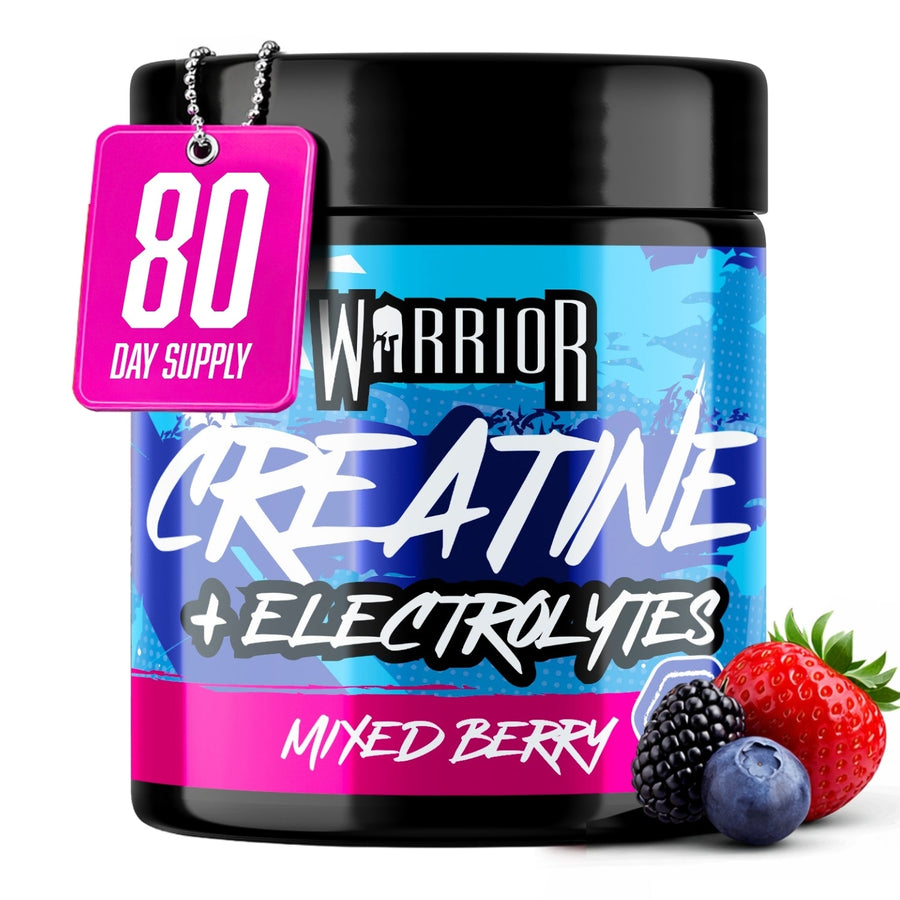
Because our customers asked us to. In our April 2026 survey of repeat customers, 52% said they stand against complicated, gimmicky formulas and 78% against cheap, under-dosed supplements. So we keep it simple: Warrior Creatine + Electrolytes is creatine plus electrolytes, Warrior Creatine + Collagen states 3.4g of creatine monohydrate per serving, and Warrior Serious Protein states 24g of protein per 30g serving. No matrix, no mystery.
Common questions
Are proprietary blends bad?
Not always, but they stop you checking whether doses are effective. If two products cost the same, choose the one that shows every amount.
Are proprietary blends legal in the UK?
UK food supplement rules require the amount of active substances to be declared in numbers. Products made for other markets may label differently, so check before you buy.
How can I tell how much of each ingredient is in a blend?
You can't from the label. Ingredients are listed in descending order by weight, which gives a clue, but not the amounts.
Do pre-workouts use proprietary blends?
Some do. Look for one that lists caffeine and every other active ingredient per serving.
The bottom line
A proprietary blend shows you the total, not the dose. That makes it impossible to know whether you're paying for effective amounts or expensive-sounding names. Choose products that show every number, compare them with evidence-based doses, and don't pay for mystery. Try Warrior Creatine + Electrolytes.
Sources
- US Code of Federal Regulations, 21 CFR 101.36 (nutrition labelling of dietary supplements; proprietary blends may list total quantity with ingredients in descending order of predominance by weight). https://www.ecfr.gov/current/title-21/chapter-I/subchapter-B/part-101/subpart-C/section-101.36
- The Food Supplements (England) Regulations 2003 (implementing Directive 2002/46/EC: amounts of nutrients or substances with a nutritional or physiological effect declared on the labelling in numerical form). https://www.legislation.gov.uk/uksi/2003/1387/contents
- Trexler ET et al. (2015). International Society of Sports Nutrition position stand: beta-alanine. Journal of the International Society of Sports Nutrition 12:30. https://doi.org/10.1186/s12970-015-0090-y
- Warrior customer surveys, April 2026: 50 repeat Warrior Creatine Plus customers (78% against cheap, under-dosed supplements; 52% against complicated, gimmicky formulas).
- Warrior: Warrior Creatine Plus Collagen (3.4g creatine monohydrate per 9g serving). https://teamwarrior.com/products/warrior-creatine-plus-collagen (checked 19 November 2026)
- Warrior: Warrior Serious Protein 500g (24g protein per 30g serving). https://teamwarrior.com/products/warrior-serious-protein-500g (checked 19 November 2026)
 Shop the guideWarrior Creatine Plus Electrolytes
From £9.49